Private jet baggage rules: plan volume first, argue weight later
Searches for private jet baggage rules often hope for one universal kilogram number. That number does not exist across all aircraft, operators, and missions. What does exist is a practical discipline: private cabins are constrained by volume, payload, and secure stowage—and the right time to discover a conflict is before aircraft lock, not on the ramp.
This LUKS Aviation guide explains volume versus weight, large cases, strollers, golf and ski gear, sensitive equipment, liquids and medications, and how to send a usable baggage list. Pets are only a pointer here—use the dedicated article private jet travel with pets Turkey. For charter context see private jet charter in Turkey and book a private jet.
Contents
- The myth of one universal limit
- Volume vs weight
- Large cases and garment bags
- Strollers and family items
- Golf, ski, and sports gear
- Sensitive and fragile gear
- Liquids and medications
- Pets (brief pointer)
- Send the list before aircraft lock
- Common mistakes
- Frequently asked questions
- Conclusion
- Sources and official references
The myth of one universal limit
Airlines publish fare-class bag tables because they sell seats on standardized fleets. Private aviation sells a whole aircraft with a specific serial, specific cabin layout, and specific payload remaining after fuel planning. Copying a commercial “23 kg × 2” rule onto every light jet is how garment bags end up in the wrong place.
Ask for baggage guidance tied to the aircraft offered on your quote—not a generic internet chart.
Volume vs weight
| Constraint | What it means | Client action |
|---|---|---|
| Volume | Will the cases physically fit in baggage compartments / approved cabin stowage? | Share dimensions or clear photos of oversized items |
| Weight / payload | Passengers + bags + fuel plan must remain within limits for the airports and conditions | Share honest passenger count and heavy-item notes |
| Secure stowage | Items must be secured for taxi, takeoff, and turbulence | Avoid last-minute loose odd-shaped cargo |
A soft duffel that “weighs little” can still win a volume fight against a cabin designed for a different layout. Conversely, dense cases can pass the tape measure and still stress payload on a short-field or hot-day departure. Both matter.
Large cases and garment bags
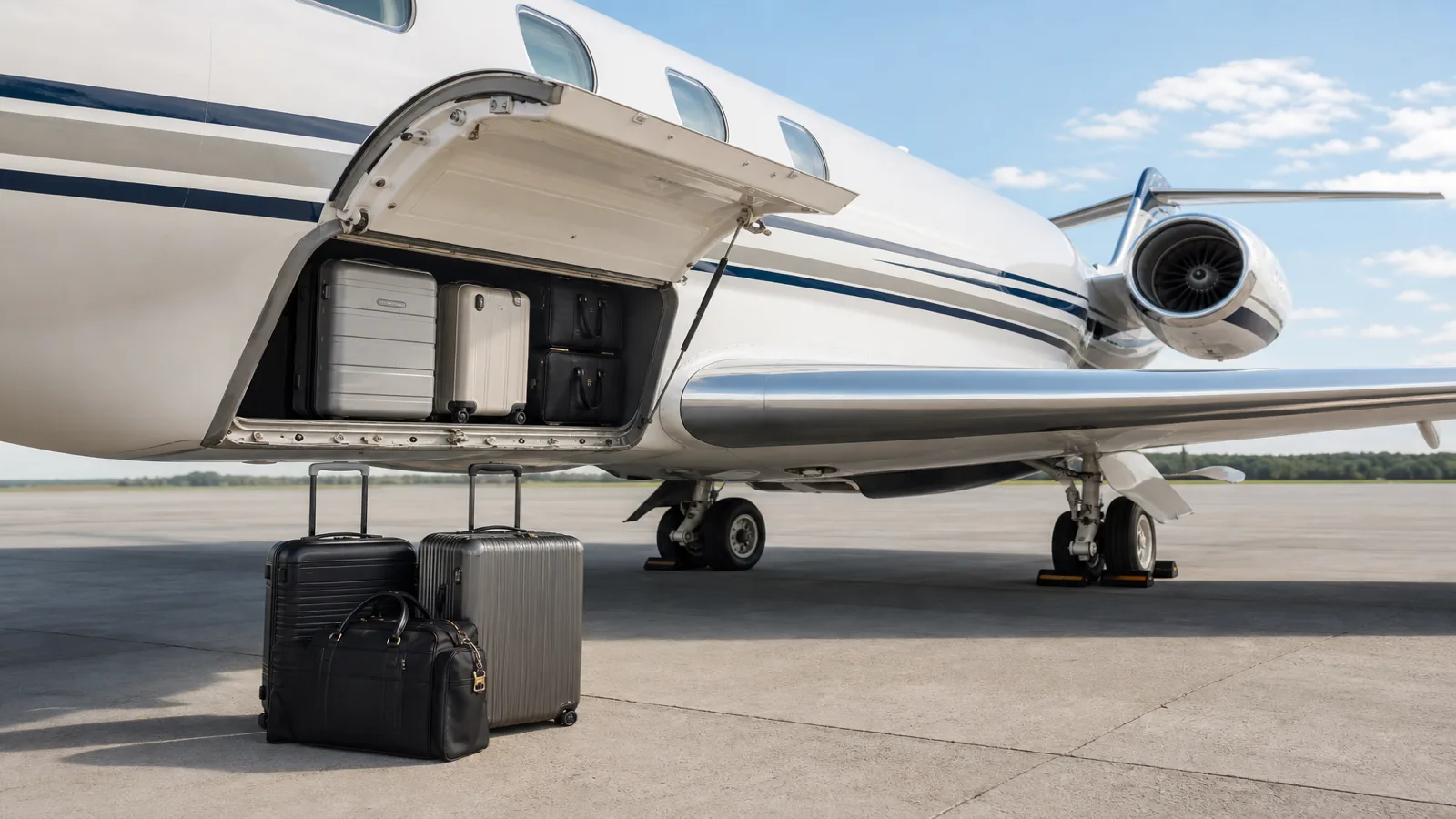
Rigid oversized suitcases are the most common surprise. If your party travels with multiple large hard cases for a week-long villa or wedding, say so while category selection is still open. Midsize and larger cabins often absorb volume more calmly than the smallest light jets—but confirm for the serial offered.
Garment bags for formal events are usually manageable when declared; they become painful when three appear at the stairs unannounced. Photography trunks and sample cases belong in the first brief, not the WhatsApp thread at wheels-out minus twenty minutes.
Strollers and family items
Folding strollers, pack-and-plays, and child amenities change usable space. Ask early whether a stroller must travel in the cabin or can be hold-stowed per the operator’s practice for that aircraft. Child seats, where accepted, need model honesty and installation planning—never assume airline rules map one-to-one onto a specific business jet.
Family charters also accumulate “small” bags that are not small in aggregate. Count them.
Golf, ski, and sports gear
Golf bags and ski cases are classic private-aviation special items. They are often feasible on the right aircraft with advance notice; they are awkward when discovered after a light cabin was locked. Share approximate lengths and whether soft or hard cases are used.
Bicycles, dive gear, and hunting equipment (where lawful) need explicit declaration because shape and regulation interact. If an item might be restricted, ask before travel day—do not improvise at the FBO.
Sensitive and fragile gear
Musical instruments, camera housings, medical devices (for ordinary passenger travel—not air-ambulance missions), and prototype hardware need shock and temperature honesty. Describe fragility and whether the item must remain in the cabin with a passenger. Lithium-battery-powered devices should follow operator and dangerous-goods practices; when unsure, declare early so ops can advise within the rules.
For aviation dangerous-goods framing at a high level, regulators and industry bodies publish guidance; start from authorities such as ICAO and national authorities including SHGM rather than informal packing myths.
Liquids and medications
Private aviation is not a free pass to ignore dangerous-goods and security rules. Large liquid volumes, alcohols for events, and chemicals need declaration. Personal medications should travel with the passenger who needs them, in original packaging when practical, with prescriptions available if a destination may request them. Temperature-sensitive meds should be flagged so cabin procedures can be discussed—without turning the charter desk into a pharmacy.
Pets (brief pointer)
Pet travel changes aircraft choice, documentation, and cabin planning. Do not bury a dog or cat in a baggage list. Use the dedicated guide: private jet travel with pets Turkey.
Send the list before aircraft lock
- List bags by type: carry soft, carry hard, checked-size, oversized, sports, fragile
- Note approximate counts per passenger
- Photo any item longer than a typical large suitcase
- Flag lithium batteries, liquids in volume, and medical devices
- Send the list with the passenger names before you approve the aircraft
- If bags grow after lock, tell ops immediately—silent growth is how departures slip
This habit also improves quote quality. Category recommendations on fleet browsing become meaningful only when volume is honest. Pricing implications of a larger cabin are easier to accept early than as an emergency upgauge—see private jet prices in Turkey.
Common mistakes
- Assuming commercial airline bag allowances apply unchanged
- Hiding golf or ski cases to “keep the quote low”
- Counting only suitcases and forgetting garment bags and backpacks
- Adding passengers and bags after performance was calculated
- Treating the baggage hold like an infinite van
Event and wedding baggage spikes
Weddings and milestone events create private jet baggage rules stress because garment volume spikes. Multiple formal outfits, gift boxes, and photography kits arrive together. Brief aviation with an event mindset: list garment bags separately, note gift dimensions, and say whether items may travel earlier on a commercial shipment instead of in the cabin. Event planners should send one consolidated bag list rather than each guest emailing the broker. If the party splits across two aircraft, assign bags to aircraft deliberately so the dress and the person land together.
Corporate sample cases and tools
Sales and engineering teams sometimes carry sample cases that look ordinary until weighed. Dense equipment can dominate payload. Share weights when known, and ask whether cases must remain in the cabin. Tools that resemble restricted items should be declared for a lawful review rather than discovered at screening. Corporate EAs should keep a reusable bag profile for frequent flyers to paste into each new brief.
Weight-and-balance is not a suggestion
Even when cases fit by volume, loading must respect weight-and-balance for the specific aircraft and fuel plan. Moving heavy cases around the cabin without crew guidance is not a passenger privilege. Follow crew instructions for stowage. If you discover an extra trunk at the curb, tell the crew before engines start—not after. Last-second honesty still beats silent risk. Travel managers should also track cumulative extras: retail purchases, conference swag, and gift boxes acquired at destination can break a carefully planned return payload. Build a return-bag note into multi-day trips.
Security and dangerous-goods mindset
Private terminals feel calmer than crowded commercial piers, but calm is not exemption. Restricted items remain restricted. When unsure about batteries, aerosols, or sporting ammunition where lawful, declare and ask before travel day. Operators will apply their manuals and applicable regulations. International itineraries may also involve destination rules that differ from departure norms. Educational references from ICAO, EASA, IATA, and SHGM help frame why declarations matter; they do not replace the operator’s acceptance decision on the day.
Reusable baggage profile for frequent flyers
Executive assistants should keep a reusable baggage profile per frequent principal: typical hard cases, garment bags, sports gear seasons, and medical devices. Paste it into each new charter brief and update deltas only. This habit reduces undersize aircraft selections and prevents the “we always travel light” fiction that collapses on wedding weekends. Share photos once for recurring oversized items so ops is not rediscovering the same ski case each winter.
Frequently asked questions
Is there a standard private jet baggage weight limit?
No single universal limit applies to every aircraft and day. Limits are mission- and serial-specific.
Can I bring more bags than on a commercial first-class ticket?
Sometimes volume allows more flexibility—sometimes payload or compartment shape allows less. Brief the real list.
When should I send photos of oversized items?
Before aircraft lock, ideally with the first complete brief.
Are liquids unrestricted on private jets?
No. Dangerous-goods and operator rules still apply. Declare volumes and special items.
Where do pets fit?
Pets are not ordinary baggage. See the pets guide linked above.
Will a larger jet always solve baggage problems?
Larger cabins often help with volume, but performance, airports, and cost still matter. Ask for options.
Conclusion
Private jet baggage rules are less about memorizing a number and more about honesty: volume, weight, stowage, and timing. Send the list before aircraft lock, declare special gear early, and keep pets on their own planning track.
When your bag list is ready with the passenger list, To request a route-specific quote, use book a private jet or reach the team via contact.