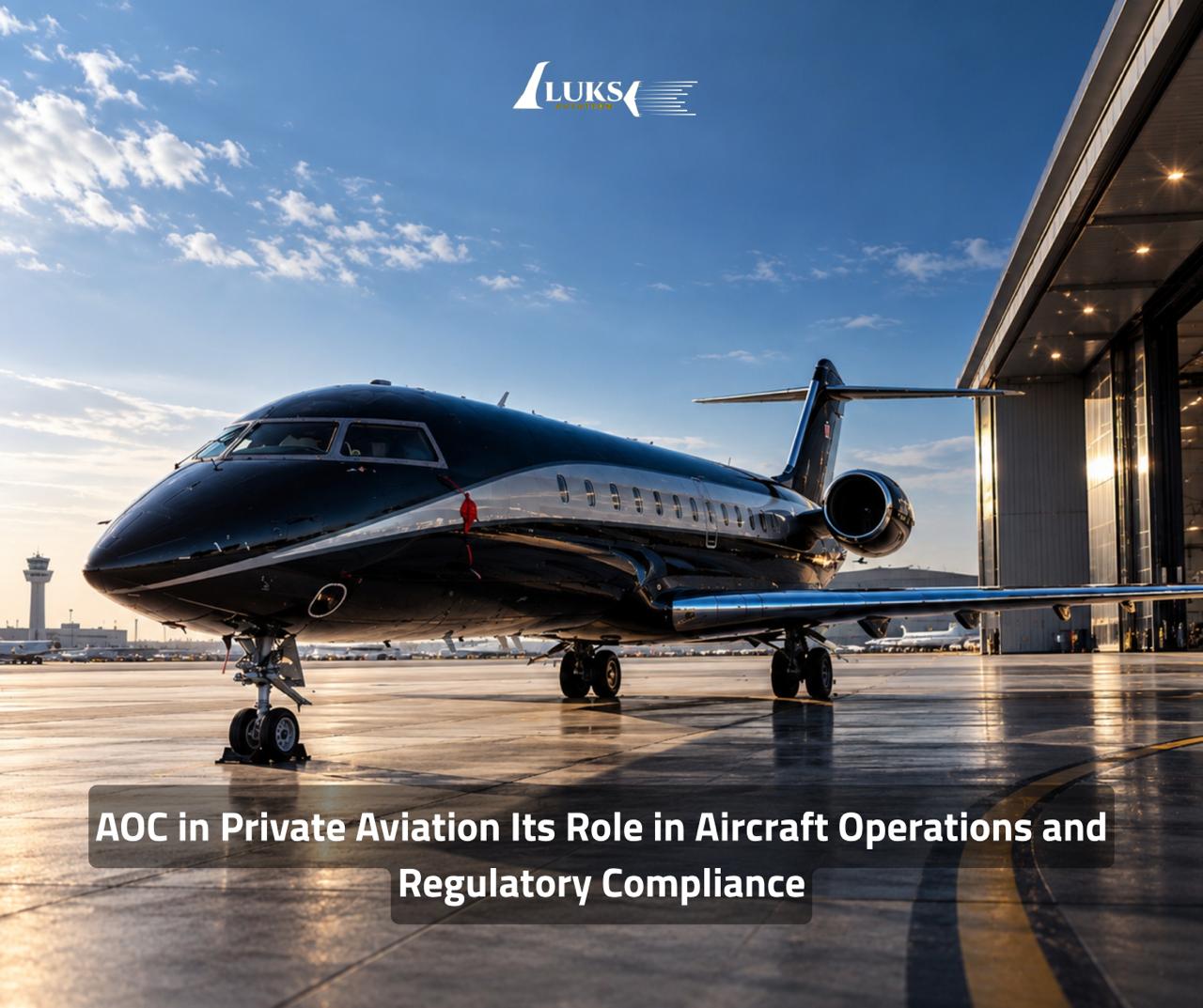
AOC in Private Aviation: Aircraft Operations and Compliance
AOC in Private Aviation: When people talk about private aviation, the conversation usually starts with the aircraft itself. They ask about the jet, its range, cabin, speed, or where it can fly. The operational side is less visible, even though it is what keeps the aircraft moving legally and safely from one airport to another.
This is where an Air Operator Certificate (AOC) becomes important.
An AOC is part of the regulatory framework used to authorize certain types of commercial air operations. It is issued by the relevant civil aviation authority after an operator has demonstrated that it has the people, procedures, aircraft and systems needed for the operations it intends to conduct.
For companies working in business and private aviation, the important point is that an AOC is not simply a certificate on paper. It is connected to the way flights are planned, crews are managed, aircraft are maintained and operational decisions are made.
What Is an AOC in Private Aviation?
An Air Operator Certificate confirms that an aviation operator has met the regulatory requirements applicable to its approved operations.
The certificate does not normally give an operator unlimited freedom to operate any aircraft on any route. Its scope is linked to the operator’s approved activities and, where applicable, its operations specifications.
This distinction matters in private aviation because the word “private” can describe several different situations.
A privately owned aircraft used by its owner is not necessarily operating under the same rules as an aircraft used to provide commercial air transport. The regulatory requirements depend on the type of operation, the aircraft, the jurisdiction and the way the flight is conducted.
ICAO’s framework treats the AOC as part of a wider certification and oversight system. The authority does not simply issue the certificate and walk away. Operators remain subject to regulatory oversight after certification.
That ongoing relationship between the operator and the aviation authority is one of the most important aspects of an AOC.
Does Every Private Aircraft Operation Need an AOC?
No.
This is one of the first points that needs to be made clear.
Owning a private jet does not, by itself, require the owner to hold an AOC. The rules may differ when the aircraft is used privately rather than to provide commercial air transport. A personal flight to another country puts the owner in a different regulatory position from an operator carrying passengers for payment. European aviation law draws similar lines between types of operation. Certain specialized flights may take place without an AOC, though they can still require separate approvals and compliance with other rules.So the better question is not simply, “Does this aircraft need an AOC?”
The useful question is:
What type of operation is being conducted, and which regulatory framework applies to it?
That answer determines what certification and approvals are required.
What Changes When an Aircraft Operates Under an AOC?
Once an operation falls within an AOC framework, aircraft activity becomes part of a much more structured system.
A flight cannot be looked at in isolation. The operator has to consider the aircraft, crew, route, weather, airport conditions, technical status and operational requirements together.
AOC in Private Aviation: Flight Planning
Flight planning is one of the most visible parts of aircraft operations, but there is considerably more involved than simply choosing a route.
Before departure, the operational team may need to review weather conditions, fuel requirements, aircraft performance, airport restrictions, NOTAMs, airspace limitations and destination requirements.
International flights can add another layer of work. Depending on the countries involved, permits, handling arrangements and overflight or landing permissions may need to be arranged in advance.
A change to the schedule can also affect several of these elements.
For a business aircraft, that happens frequently. A meeting may finish earlier than expected. A passenger may request a different departure time. Weather may change during the day.
The operations team has to adapt without losing control of the flight’s safety and regulatory requirements.
Crew Management Is Part of the Operational Picture
The aircraft is only one part of the operation.
The crew has to be properly qualified for the aircraft and the type of operation, while training, recurrent checks, duty periods and scheduling also need to be managed.
This becomes particularly important when an operator has aircraft flying regularly or operating across different countries.
A professional operator cannot rely on an informal system where a pilot is simply called whenever a flight is requested. Crew availability has to be considered alongside aircraft availability and the planned mission.
It is also why changes made at short notice can require more coordination than passengers may realize.
Moving a departure by several hours might affect crew duty limits, positioning, rest arrangements or even the availability of another crew member.
Aircraft Maintenance and Operational Readiness
Maintenance is closely tied to flight operations.
An aircraft may be technically capable of flying in general terms, but its actual availability for a particular mission depends on its maintenance status and any outstanding technical requirements.
Operators therefore need a clear picture of the aircraft’s condition before confirming a flight.
Scheduled inspections, maintenance events, technical defects and required documentation all form part of that picture.
This is especially relevant to business aviation, where aircraft are often expected to operate on relatively demanding schedules. A good operational system allows maintenance planning and flight scheduling to communicate with each other instead of working as separate departments.
The AOC and Operations Specifications
One area that is often overlooked when discussing an AOC is the operator’s Operations Specifications.
The AOC provides the basic authorization, but the operations specifications help define the scope of the activities the operator is approved to conduct.
This is why two operators can both hold an AOC while having different operational capabilities.
Their approvals may cover different aircraft, routes, types of operation or additional authorizations.
ICAO’s model documentation links the AOC to the operations specifications and the operator’s approved operations manual.
For a client or aircraft owner, this means that asking whether an operator has an AOC is only the first step.
It is equally useful to understand what that AOC actually covers.
Questions worth asking include:
- Which aviation authority issued the certificate?
- What type of operations is the operator approved to conduct?
- Which aircraft are covered?
- What geographical limitations apply?
- Are additional operational approvals required for the intended flights?
- Does the operator have experience with the destinations and missions involved?
These details can tell you much more about an operator’s practical capabilities.
Regulatory Compliance Does Not Stop After Certification
Getting an AOC is not the finish line.
An operator has to maintain the standards that allowed it to receive the certificate in the first place.
That can involve internal procedures, training, documentation, safety management, maintenance oversight and regular interaction with the aviation authority.
The situation can become more complicated as the business grows.
Adding another aircraft, changing the fleet, introducing a new type of operation or expanding international activity may require additional regulatory work.
The same applies to changes in operational procedures or organizational structure.
This is why compliance in aviation is an ongoing responsibility rather than a one-time administrative task.
International Operations Require Extra Planning
Private and business aviation often involves international travel.
A single flight may cross several jurisdictions before reaching its destination. The operator therefore has to look beyond the rules of its home country.
Depending on the route, the operation may involve:
- Overflight permits
- Landing permissions
- Airport slots
- Ground handling
- Customs arrangements
- Immigration requirements
- Local operating restrictions
- Special airport procedures
The requirements are not necessarily the same from one country to another.
Good preparation can make the difference between a straightforward flight and a last-minute operational problem.
For corporate passengers, this is particularly important. The value of private aviation is partly its flexibility, but that flexibility depends on an operations team capable of responding quickly when plans change.
Aircraft Ownership Is Not the Same as Aircraft Operation
Another point worth clarifying is the relationship between ownership and operation.
The company or individual listed as the aircraft owner does not necessarily have to be the same entity responsible for operating the aircraft.
Aircraft management, ownership and commercial operation can involve separate responsibilities, depending on the structure and regulations involved.
An owner may, for example, rely on a professional aviation company for operational management while retaining ownership of the aircraft.
That arrangement can involve coordination between the owner, operator, maintenance providers, crew and other aviation service companies.
The important issue is that everyone understands who is responsible for what.
Why Does This Matter to Business Aviation Clients?
For a passenger, the regulatory structure behind a flight may never be visible.
They see the aircraft arrive, board, fly to the destination and land.
Behind that relatively simple experience, however, there may have been several people coordinating the aircraft, crew, flight plan, airport services and regulatory requirements.
This is particularly true when the itinerary involves several countries or changes close to departure.
A professional operational structure allows those changes to be handled without turning every request into a disruption.
For companies, this matters because executive travel is often connected to meetings, projects, negotiations and time-sensitive decisions. Reliability is therefore just as important as comfort.
Safety and Operational Control
An AOC is also connected to the operator’s wider safety responsibilities.
Modern aviation safety is not based solely on checking whether an aircraft is mechanically sound. Operators also need systems for identifying operational risks, managing them and learning from safety information.
Crew members, operations personnel, maintenance teams and management all contribute to that process.
The purpose is not to make aviation unnecessarily complicated. It is to make sure that important decisions are not left to chance, especially when circumstances change.
Weather disruptions, technical issues, airport restrictions and schedule changes are all part of real-world aviation.
A capable operator needs procedures that allow those situations to be handled in a controlled way.
AOC Requirements in Turkey
Turkey’s civil aviation system is overseen by the Directorate General of Civil Aviation (SHGM).
SHGM has different categories and regulatory requirements for air operators depending on the nature of the activity. The authority treats airline operations, air taxi services, and general aviation as separate areas.
That distinction is another reason to use the term “private aviation” cautiously when discussing AOCs. Calling an aircraft a business jet does not determine which certificate or operating rules govern it. What matters is how the aircraft is actually operated. For companies based in Turkey, that distinction must be addressed when planning an aviation structure because the applicable SHGM requirements depend on the operation itself.What Should Aircraft Owners Consider When Choosing an Operator?
An AOC is an important starting point, but it should not be the only factor considered.
Aircraft owners and companies may also want to look at the operator’s experience, aircraft types, operational coverage, crew management, maintenance coordination and international capabilities.
It is also worth considering whether the operator is familiar with the type of flying required.
A company arranging occasional domestic flights may have very different needs from an owner who expects regular international business travel.
The right operator is therefore not necessarily the largest one. It is the one whose capabilities and operating structure fit the aircraft and the missions being planned.
LUKS Aviation and Aircraft Operations
For LUKS Aviation, professional aircraft operations are built around the practical requirements of business and private aviation.
For aircraft owners and business aviation clients, the result should be straightforward: the operational side is handled professionally so they can focus on the purpose of the trip itself.
Final Thoughts
An AOC in Private Aviation is best understood as part of a wider operating system.
It establishes a regulatory framework for approved operations, but the real work continues every day through flight planning, crew management, aircraft maintenance, operational control and compliance.
It is also important not to assume that every private aircraft requires an AOC. The answer depends on the nature of the operation and the rules of the relevant aviation authority.
For operators, owners and corporate aviation clients, understanding this distinction makes it easier to assess how an aircraft will actually be operated.
In the end, a professional aviation operation is not defined by the certificate alone. It is defined by what happens behind it: the procedures, people, decisions and systems that keep each flight within the required safety and regulatory framework.
Frequently Asked Questions
What is an AOC in private aviation? An AOC, or Air Operator Certificate, is an authorization issued by an aviation authority to an operator that has demonstrated its ability to conduct specified operations in accordance with applicable regulations.
Does a privately owned jet automatically need an AOC? No. Simply owning the aircraft does not trigger an AOC requirement. What matters is how the jet is operated. What is the difference between an AOC and aircraft ownership? Ownership identifies the party that holds the aircraft as an asset. An AOC, by contrast, authorizes an operator to carry out defined air operations. The aircraft owner and the operator may be separate entities, depending on the applicable legal and regulatory arrangements. What do Operations Specifications mean? They set out the operating authority granted to an AOC holder, including the aircraft and conditions covered, along with any specific approvals. Does an AOC allow every flight to operate anywhere? No. Its authority has limits. International operations may also need extra permissions or permits and must comply with the regulations of each country involved.read more:
Private Aviation and Luxury Services: Your Complete Guide
The Future of Private Jets: Will We See Supersonic Speeds?
Chartering a Private Jet for Special Occasions: Tips and Guidelines
Aircraft Management Services for Business & Private Jets luks.aviation